Mostrar mensagens com a etiqueta Joseph Pilates. Mostrar todas as mensagens

quarta-feira, 13 de setembro de 2023

Joseph Pilates and friends


Joe, Clara, Ted Shawn and Friends from Pilatesfan on Vimeo.


*Ted Shawn (1891-1972) was an American dancer, choreographer, educator, and founder of Jacob's Pillow, an internationally renowned dance education center and performance space. With Ruth St. Denis, he created the Denishawn School of Dance, the first dance school to produce a professional company in the United States.

quarta-feira, 3 de julho de 2019

quarta-feira, 23 de janeiro de 2019

Pilatesology join Jay Grimes- 5 Minute Computer Refresher Workout

Start taking care of yourself for a happier body and mind .
Jay Grimes is a wonderful teacher.
I just love this funny routine.


"Jay began his studies with Joe Pilates in the mid-sixties, and after Joe’s death continued with Joe’s wife, Clara, for another 10 years until her death. Jay began teaching in the original 8th Avenue studio in New York and has since taught all over the world. Jay danced professionally, ballet and Broadway for 18 years, and never had an injury. This he attributes entirely to Pilates.

Jay is valued in the Pilates community for his experience, humility and integrity in maintaining the work of Joe Pilates. Over the years Jay’s clients have ranged from stars of Broadway and Hollywood, music and opera, to politicians, businessmen and housewives, and Olympic athletes. He currently provides ongoing training to instructors, conducting workshops and master classes around the world."  


sábado, 26 de maio de 2018

sábado, 13 de janeiro de 2018

Joseph Pilates Home , Footage of Original Pilates Apparatus; Joseph Pilates at Jacob's Pillow


 Quatro vídeos com interesse documental, não só para quem gosta de Pilates, mas também para quem tem curiosidade em conhecer a história da evolução do exercício físico em geral.
   Documentos que têm também a virtude de  concretizarem  uma quase abstracção ao  revelarem aspectos da vida e da personalidade de Joseph Pilates.    
 Em  1964  escrevia-se no New York Herald Tribune : “Em aulas de dança pelos Estados Unidos, centenas de jovens treinam diariamente um exercício que conhecem como sendo Pilates, sem saber que a palavra tem letra maiúscula e corresponde ao nome próprio de uma pessoa real e viva". 
   O método Pilates generalizou- se  e é ensinado´e praticado  por muita gente - cada vez mais- em todo o mundo.
  No entanto em 2018 mantém-se, inexplicavelmente, o desconhecimento geral relatado em 1964.  É também por isso que estes registos são fundamentais  e escolas como a Jacob's Pillow Dance ( a "meca da dança"), o seu arquivo , festival e trabalho de   divulgação públicos , têm um valor inestimável.   

  A) Joseph Pilates HomeBelates history. See the studio that Joe built, the tiny hunting shack they lived in, the gate (built by Joe) that fronts the property, the mysterious beginnings of more buildings and more. Sean Gallagher, the property's current owner, shares his story of how he came to purchase the property, details what he found there when he took possession, and what he intends to do with it in the future.


B) Footage of Original Pilates Apparatus
 In this 2nd part of our visit to Joe and Clara Pilates' summer home in Becket, Massachusetts, you'll see exclusive footage of the apparatus that was left, practically untouched since the 1960s, in the studio Joe built there. Sean Gallagher shows us original items like the V Beds Joe and Clara slept on, an early version of the Arm Chair, a Reformer built for home use, a Cadillac, an Electric Chair that was originally a Wunda Chair, Magic Circles, and more.


C) Joseph Pilates at Jacob's Pillow
JosephPilates taught for approximately 15 years at Jacob's Pillow Dance Festival in Becket, Massachusetts and bought a large piece of property a short distance away where he and Clara visited often. In this fascinating interview, Norton Owen, Archivist at Jacob's Pillow, shares a glimpse into Joe's personality, activities and ambitions seen through the records left behind. See photographs, notes taken by students in Joe's classes, an extremely candid letter about Joe written by Pillow founder Ted Shawn, and more.

D)Pillow Talk: Pilates at Jacob's Pillow
This excerpt from an hour-long PillowTalk features remembrances of Joseph H. Pilates by some of those who studied with him at Jacob's Pillow in the 1940s and 1950s, along with commentary by Pilates practitioner Sean Gallagher, Scholar-in-Residence Philip Szporer, and Director of Preservation Norton Owen.


quarta-feira, 7 de junho de 2017

Isle of Man by Jonathan Grubb


(Brett Miller -Pilates Intel)

"I am very fortunate to live on a wonderful, scenic and peaceful island called the Isle of Man. However, when Joseph Pilates spent 3½ years on the island from late 1915 to early 1919, he was strictly confined within the largest internment camp built for First World War “enemy aliens” and would not have enjoyed quite the same benefits of island life as I do today.

Knockaloe Internment Camp, where Joseph was held (along with my own great-grandfather) has been “well described by a visitor as being like a glorified chicken run. Not only were the huts suggestive of enlarged hen-houses, but the aimless wandering of the men round and round the compounds, in dust or in mud, according to the weather, brought to mind the scratchings of cooped chickens in their already well-scratched-over soil.” (“St Stephen’s House, Friends’ Emergency Work in England 1914 to 1920” by Anna Braithwaite Thomas and others)

Approximately 23,000 men were held at the camp within an area covering only 22 acres (this is less than 17 football/soccer fields). At the outbreak of the war, Britain was a very different place than it is today and attitudes to German, Austrian, Italian and Turkish (described at that time as “enemy aliens”) were very strong. Joseph arrived by boat on the island in the dark of night when locals were less likely to see the new internees. He was then transported by steam train to the camp, to awake the next morning enclosed within his new barbed wire-surrounded home.

How did Joseph deal with the challenges he faced during that time? Lolita San Miguel (first generation Pilates teacher certified by Joseph Pilates) recounted to me that Joseph did not speak much of his time on the island. However, she remembered that when she did ask him about it, he always said that he was actually very glad for the time he spent on the Isle of Man as it gave him the time and opportunity to work on his method, which he may not have otherwise had.

Joseph displayed an admirably positive attitude in the midst of a very tough situation. His confinement was overshadowed with no knowledge of the future outcome or duration of the war, coupled with severely restricted food and resources. The living conditions were not pleasant and men were dying around him, not only from illness, but as Joseph observed, from lack of hope and stimulation in life. However, Joseph used the time as an opportunity to develop his method towards radically improving the lives of the sick, injured and increasingly hopeless men around him.
 
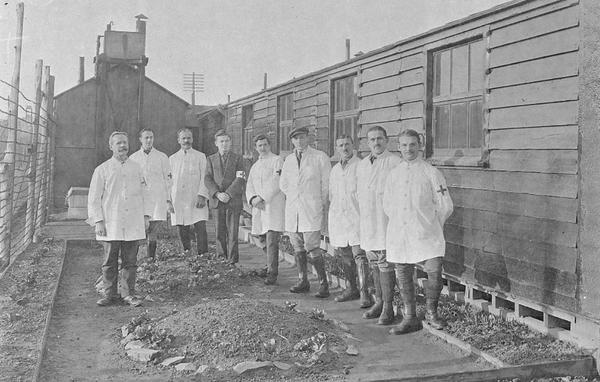
Knockaloe Camp was divided into four camp areas (camps 1-4) and movement between camps was prohibited unless special permission was granted by the Camp Commandant. Each camp had its own hospital unit. Joseph Pilates was held in camp 4 therefore he may well have worked in the hospital unit of camp 4, but it is also possible (although not proven) that he could have been granted permission to work in other camp hospitals.
​​​​​​​

Image

After looking through the many digital images of unnamed internees at the Isle of Man Museum, I stumbled across a photograph which shows an internee hospital orderly with army and civilian medics either side of him. The internee in the picture bears a remarkably strong resemblance to Joseph Pilates and was taken outside camp 2 hospital. In that day, the norm was to wear a moustache, although Joseph never did. The wave of the man’s hair and his stance is notably similar to pictures of Joseph outside his internment. If the internee in the picture is Joseph, then he clearly worked in the different camps, and was well respected to have been the only internee in the picture.

There is little evidence to substantiate the stories that surround Joseph’s time at Knockaloe. However, there are some significant and key statements reported as being made by Joseph himself. To my knowledge, none of those statements were ever disputed by any of the many men who were interned and lived through those challenging times alongside him.

Within an article by Doris Hering which appeared in Dance Magazine, February 1956 (p.76) entitled “They All Go to Joe’s”, referring to Joseph’s time in the camp: “There he encountered people who were disabled as a result of wartime diseases and incarceration. He began devising machines to help in their rehabilitation.”

In 1962, Robert Wernick interviewed Joseph Pilates for Sports Illustrated magazine where Joseph stated that “the full principles of Contrology were revealed to him during World War I”. The article went on to state “[Joseph] began demonstrating these exercises to the dejected figures around him, and since they had nothing else to do, they began to do the exercises too. Awkwardly and timorously at first, but under his firm supervision they became more and more confident, more and more bouncy, like cats. They ended the war in better shape than when it started.”

The letter to Joseph Pilates which appeared in Return to Life through Contrology included the following excerpts: “To our friend, Mr Pilates, professor and instructor of physical education, always willing”; “the most unselfish during four and a half truly horrible years”; and “relying on his training we ought to feel fit, physically and spiritually, to the end”.

Could he have used springs from beds to develop rehabilitation equipment? Yes, of course he could. I have tested the theory and it works. Whilst no evidence exists that the hospital bed frames had springs which Joseph could have utilised, there is no evidence either to the contrary. Every Victorian/Edwardian era bed I have seen, especially those referred to as a ‘hospital bed’ have had springs attached at one or both ends of the bed frame.

Life at Knockaloe Camp is being fully researched and documented by a charitable trust (
www.knockaloe.im) and their important research is helping to bring the story to life. The charity intends to have a museum and visitor centre opened by April 2018 where there will be a lasting record of what life was like in the camp, detailing the hardships and the life internees endured. Within the visitor centre, it is fitting that there will be a special section about Joseph Pilates in the place where he not only developed the foundations of the Pilates Method, but he was stirred deeply by the needs of men suffering around him. He led men who were waning physically, mentally and emotionally to move and be active; enabling them to survive, recover and make the most of the bodies and minds they had while freedom, food, hope and contact with the outside world remained restricted.

The life-enhancing benefits we experience and share each day, when we practice or teach Pilates, are thanks to an incredible German-born man, who faced some of the most serious hardships during his life - not only in childhood, but also as an adult. It is a story of triumph over adversity and of will, determination and strength of spirit as well as of mind and body which should be remembered as part of our Pilates Heritage.


Image

Jonathan Grubb was born in England in 1962 and has lived on the Isle of Man since he was two years old. His great grandfather Jakob Grub was interned on the Isle of Man until 28 August 1919 in the same camp as Joseph Pilates.
In his younger days Jonathan was a keen amateur sportsman and particularly excelled at football (soccer), representing the Isle of Man in international games on numerous occasions. An anterior cruciate ligament injury sustained towards the end of his playing days led him to discover Pilates and he has been a passionate practitioner ever since. He has traveled to various countries to attend conferences and courses and been fortunate to be mentored by very experienced local teachers.

Having previously been an advanced instructor for several years in the Wu family style of tai chi chuan, Jonathan is currently studying to become a Pilates teacher with MKPilates and his teaching has been enthusiastically welcomed in classes throughout the island already. More on the story of Knockaloe Internment Camp can be found at knockaloe.im

domingo, 30 de agosto de 2015

Memories of Joe Pilates from Bob Wernick & Chuck Rapoport


I was looking for one photo( that one were Joseph Pilates was laying down with a man stepping on him) and I found those intersting vídeo and article.
Actually the man was Robert Wernick photographed by Chuck Rapoport , who wrote   
on Setember - 2014:
"ROBERT WERNICK died end of August on the Island of Malta. Bob was the author of the famed Sports Illustrated article on Joe Pilates that ran in February of 1962. It was that article that I was called upon by S.I. to photograph Bob with Joe and Joe in his NY Studio. I met Bob Wernick that day in October 1961 when he was a client of several years working with Joe. I never saw Wernick again until last year in Paris, France - when I walked up to his 5th floor apartment - 84 steps - that he walked twice a day. Bob was 95 years old and still doing his Hundred in bed in the morning and a few of the Series of 5.- Bob was quite a man with an amazing life. You can read his short articles including the one on Mr. Pilates on Wernick's websirte/blog : www.robertwernick.com"
 A)
The article and the photo

Joe Pilates

Learning to be an Animal

There is a happy band of people, of which I am an aspirant member, who are distinguishable anywhere by their springy step and "saved" look from the mass of their contemporaries who shuffle and shamble in untidy corpulence around us. We know that we are saved because we faithfully attend exhausting but exhilarating sessions at the Joseph H. Pilates Universal Gymnasium on Eighth Avenue in midtown Manhattan.

For it is here that Joe Pilates, a white-thatched red-cheeked octogenarian, his wife Clara and Hannah (who came in for a lesson 25 years ago and stayed on) bark their stern commands as we twist and stretch and complain through the exercises forming the core of what Joe, with his Germanic taste for scientific nomenclature, calls Contrology.

Don't ask me what Contrology is. Don't ask Joe either, for orderly exposition is not one of his talents. It has something to do with rational tension and relaxation of the muscles, and it comes from a profound knowledge of bodily kinetics begun three quarters of a century ago when Joe as a child in Germany began observing his fellow children at play and animals bounding through the forest. Later, when he was making a living as a boxer and a circus tumbler he began developing a series of exercises to relax him after an exhausting day.

The full principles of Contrology were revealed to him during World War I. His circus was caught traveling in England when the war broke out in 1914, and Joe and all the others were interned in an abandoned hospital on the Isle of Man. Here, as weeks lengthened into months and years, he watched his fellow-prisoners sink into apathy and despair, with nothing to do but stare at the bare crumbling walls of their prison, nothing to break the daily monotony but the inadequate meals (for the German submarine blockade was slowly starving England) and an occasional walk around the bare courtyard with nothing to look at but an occasional starveling cat streaking after a mouse or a bird.

It was the cats which did it. For though they were nothing but skin and bones - even the most animal-loving prisoners could hardly spare them anything from their own pitiful rations when their own children were begging to be fed - they were lithe and springy and terribly efficient as they aimed for their prey. Why were the cats in such good shape, so bright-eyed, while the humans were growing every day paler, weaker, apathetic creatures ready to give up if they caught a cold or fell down and sprained an ankle? The answer came to Joe when he began carefully observing the cats and analyzing their motions for hours at a time. He saw them, when they had nothing else to do, stretching their legs out, stretching, stretching, keeping their muscles limber, alive. He began working out an orderly series of exercises to stretch the human muscles, all the human muscles. He began demonstrating these exercises to the dejected figures around him, and since they had nothing else to do, they began to do the exercises too. Awkwardly and timorously at first, but under his firm supervision they became more and more confident, more and more bouncy, like cats. They ended the war in better shape than when it started, and when the great influenza epidemic came sweeping over all the countries that had fought in the war, not one of them came down with it.

Once free, he came to America because that is the place to be when you have a new idea. He designed and built machines for carefully graduated stretching exercises, he rented a loft, he opened his Universal Gymnasium, up the street from Stillman's Gym, an institution built to other specifications. Little by little the word got around, people began coming in, people from professions which demand complete and precise control of the whole body, ballet dancers, opera singers, Laurence Olivier, Yehudi Menuhin.

When I came to join this band, he greeted me as he did everybody else. He lay down on his eighty-ear-old back and commanded, "Step on me." I hesitated. "Don't be afraid," he said. "STEP!" Gingerly I put one foot on his belly, one on his chest. "You see," he said. "It's easy."

Later I stood before him in the mandatory black trunks and he poked a scornful finger into my poor bare flesh.

"Typical," he said in ringing Teutonic tones. "Just like all of them! Americans! They want to go 600 miles an hour, and they don't know how to walk! Look at them in the street. Bent over!. Coughing! Young men with gray faces! Why can't they look at the animals? Look at a cat. Look at any animal. The only animal that doesn't hold its stomach in is the pig. Look at them all out on the sidewalk now, like pigs.

"By exercising your stomach muscles you wring out the body, you don't catch colds, you don't get cancer, you don't get hernias. Do animals get hernias? Do animals go on diets? Eat what you want, drink what you want. I drink a quart of liquor a day, plus some beers, and smoke maybe fifteen cigars.

"And what do Americans do? They play golf, they play baseball, they use half of their muscles, a quarter of their muscles. They get fat, they go jogging, they go on crazy diets, they jump up and down in crazy exercises, they have bad backs, they have beer bellies, they slouch, they complain, they have hernias.

"So, you want to learn how to do better. It's all up here, in the head. Lie down on the mat. Don't flop down, go down smoothly, like this, cross the arms, cross the legs. Now, legs in the air! Grab your ankles! Of course you can't reach them, no American can. All right, grab your calves. Make it your knees. Straight the knees! Bend forward! Now reach! No, you have to think first! Think! Up!"

It may take months to learn exactly which straining set of muscles and tendons is the object of that Up!

In the meanwhile, the neophyte is ever under someone's scornful eyes or encouraging grunts, learning the Pilates ropes - the varieties of pulls, twists, bends, crouches which he says use 25 percent more muscles than circus acrobatics and fifty or seventyfive percent more than baseball (pfui!) or golf (double-pfui!), No jumping or running, which put unnecessary strain on the heart; in fact, almost everything is done flat on your back or your stomach. No weights ("Do animals lift weights?") No bulging biceps.- Joe is more interested in muscles that will hold you up up than those that will let you knock another fellow down.

The exercises are graduated and have whimsical names: the Teaser, the Forward Rocking, the Saw, the Hanging.

Looking down from the walls of the gym are paintings, photographs sculptures of Joe, naked or loinclothed: spearfishing at 56, representing the Spirit of Air on the floor of the Nebraska state capitol at 60, skiing at 78. There are also photographs with admiring testimonials ("To the greatest,""to the one and immortal Joe"from distinguished alumni, and photostats of articles from American newspapers documenting the horrors of American posture. Through sweat-filled eyes, as you are upside down on one machine, you might see a famous publisher or producer or anchorperson bent double on another. They are all receiving the full lash of Pilatean philosophy.

"Its' the stiffness. You must open up the chest more, two inches more. Up! NO! With this muscle" poking a protuberance about his midriff which will never rise on you or me - "straight the knees! Where are you going - like an elephant?"

"Oh Joe," wails a famous ballerina. "Now you're calling me an elephant."

"I wouldn't insult the elephant. An elephant could walk into this room, and you wouldn't hear it. An elephant walks delicately. But you - clump, clump, CLUMP! Americans! Baseball players! Joggers! Weight-lifters! No wonder they come to me with arthritis! Ulcers! Animals don't have ulcers! Animals don't go on diets! Straight the knees! Out the air!"

So the minutes pass -- flipping and wriggling through the Corkscrew, the Jackknife, the Seal. It's not cheap ($5 a session, which lasts about 45 minutes) but as you go your two or three times a week, the weeks become months, and the abuse becomes scattered with a few congratulatory murmurs. Kindly Clara will admire you new sleekness, gruff Hannah will say, "Well, about time." Perhaps your head is a little higher in the street, above all the young gray faces. Aches and twinges disappear. A day comes when you are able to swing your ankles neatly into two loops hanging down from a bar way up there, stretch your body, get a firm grip on two upright poles - and climb up. You reach the top with grunts of pleasure and suddenly whoop in terror, "How do I get down?" "The same way you got up." Down you come, hand under hand, with gasps and moans and a final yell of triumph. In the hush that follows, Joe bellows out his final accolade:

"Now you are an animal"


©1962 Robert Wernick

Sports Illustrated, February 12, 1962

  B)
The vídeo:

quinta-feira, 20 de agosto de 2015

What is "Heroes in Motion®"?


A história de Eve Gentry é conhecida por todos os que, de algum modo, estão envolvidos com o método Pilates.
Era uma bailarina e coreógrafa que trabalhou com Joseph Pilates, a quem os médicos anunciaram que nunca mais poderia realizar determinados movimentos , já que os peitorais lhe tinham sido retirados após uma mastectomia radical.
Joseph Pilates trabalhou em conjunto com a bailarina aplicando, nesse processo,  os seus conhecimentos e experiência. Após um ano Eve Gentry voltava a fazer os mais avançados exercícios , facto que foi demonstrado perante um grupo de médicos nova- iorquinos ( como eu gostaria de ver  esse  filme !) . O veredicto anterior tinha sido posto em causa, por assim dizer, anulado... Uma parte da comunidade clínica de Nova Iorque não gostou e desprezou o trabalho de Pilates , chamando-lhe mentiroso. Diz-se que, desiludido, nunca mais foi o mesmo homem...
O fabuloso projecto "Heroes in Motion" de Elizabeth Larkin ( brilhante professora e estudiosa deste método) que este vídeo apresenta, inspira-se nesse extraordinário episódio de reabilitação, e comprova mais do que nunca  a ideia de que Pilates é um método de exercício físico absolutamente funcional.
   

domingo, 2 de março de 2014

sábado, 23 de março de 2013

História do método Pilates: Eve Gentry

Uma das ex-alunas de Joe Pilates,  Eve Gentry , relembra Joe e Clara, o estúdio original de NYe define o método Pilates como, mais do que um sistema de exercícios, um conceito ou filosofia de vida.


Eve Gentry was a modern dancer who helped found the Dance Notation Bureau in New York City and later established in 1991 with Joan Breibart and Michele Larsson the Institute for the Pilates Method in Santa Fe, New Mexico. She was an original disciple of Joseph Pilates, and a master teacher of his technique to generations of instructors.

Persistent back and knee problems led her to investigate, and later teach, a system of physical conditioning devised by Joseph Pilates. She taught "Contrology" at the Pilates Studio in New York from 1938 through 1968. Gentry also taught "Pilates" in the early 1960s at New York University's, Tisch School of the Arts Theater Department. In 1968 she moved to New Mexico, where she established a Pialtes Studio on Camino de la Luz and, in 1991, an institute devoted to the Pilates method.
In 1979, she was given the "Pioneer of Modern Dance Award" by Bennington College. She was also deemed a Living Treasure by the State of New Mexico. 

She died on June 17, 1994, at her home in Santa Fe. She was 84.

The lady in this video is Eve Gentry:


Extraordinária a forma como Eve Gentry foi reabilitada, após uma mastectomia, por Joseph Pilates:
http://pilates.about.com/b/2012/07/09/dont-worry-we-fix-joseph-pilates.htm 


Eve Gentry ensinando Pilates:


sábado, 9 de março de 2013

Entrevista feita por Marie Beynon Ray a Joseph Pilates em 1934 , publicada na Revista Readers Digest


Artigo de Entrevista com Joseph Pilates - Physio Pilates from Physio Pilates


Nota: O artigo  original,  em inglês, poderá ser lido usando as funcionalidades deste slideshare, nomeadamente o zoom e o ecran inteiro


Tradução (português do Brasil):


Eu me encontrei com uma velha conhecida outro dia que eu não via há dois anos, e quase passei direto porque ela estava, não mais velha, mas tão mais nova. Tratamento facial, tratamento endócrino, será que se apaixonou? Nada disso. Não era o rosto que estava mais jovem – mas também não é o rosto que envelhece primeiro. É o corpo que se torna flácido e encurvado...

“O que eu tenho feito”, minha amiga admitiu, “é freqüentar uma academia. Eu me vi num espelho de corpo inteiro quando esta usando menos do que um maiô – e fiquei revoltada. Resolvi então fazer algo a respeito, e fiz.”

No dia anterior eu havia conversado sobre esse mesmo assunto com o Dr. Kristian Hansson, diretor de fisioterapia no Hospital de trauma e para pessoas com necessidades especiais em Nova York. Ao falar sobre deformidades como postura encurvada, ombros caídos, peito chato, abdômen protruso que surgem com a idade, ele disse:

“Na juventude o corpo é largo no tórax e estreito no abdômen, mas à medida que a idade avança, ele se torna estreito no tórax e largo no abdômen. Se trabalharmos para evitar isso, o que podemos fazer através do exercício, nossos corpos levarão as linhas da juventude para a velhice. O abdômen possui músculos potentes, quatro camadas desses músculos, que atravessam o abdômen horizontalmente, verticalmente e obliquamente. Imagine só que espartilho! As mulheres que mantém esse espartilho forte e flexível como na juventude não precisam de nenhum outro. Mas quando esses músculos se tornam flácidos, todo o corpo se enverga. Podemos corrigir essas anormalidades em praticamente qualquer idade.”

Eu olhei agora para o homem que tinha vindo para ver, Joseph Pilates, a prova viva da verdade dessas afirmativas. De pé ali vestido no seu calção, ele aparentava vinte e poucos anos, mas ele me assegurou ter 54 anos e eu não conseguia acreditar. Pilates criou um sistema de exercícios ainda usado pela polícia de Hamburgo; foi pintado e esculpido por inúmeros artistas famosos, e consegue fazer mais com uma mão do que muitos campeões com o corpo inteiro.

“Esportes são maravilhosos para a constituição geral,” diz ele, “mas tem pouco valor para corrigir o que está errado com o corpo – e existe algo de errado com praticamente todo mundo. ‘Exercícios corretivos” são a única maneira de desenvolver um corpo bonito, forte e jovem. Os médicos concordam conosco neste aspecto.

Segundo os médicos para as nossas deformidades existe uma causa e uma cura. Nossos corpos geralmente se deformam devido à má postura; e para obter a postura correta apenas uma ordem (temos a autoridade de Pilates para isso) é necessária: “contraia o abdômen.”

Veja a descrição de um homem ou mulher de meia idade: Cabeça pra frente – duas ou três polegadas afastada do alinhamento com a coluna; ombros caídos, peito escavado, costas curvadas para frente notadamente na altura da cintura, abdômen protuso. Praticamente todos os defeitos do indivíduo, numa última análise, se resumem numa questão de coluna reta como é visto em crianças normais. Para corrigir a coluna o temos que fazer, basicamente, é “puxar o abdômen para dentro.”

Parece simples, não é? Mas deve ser feito de uma maneira especial. Os quadris devem ser jogados para frente; o abdômen inferior contraído forçando, assim, a elevação do peito e da cabeça, sem levantar os ombros – e esta postura deve ser mantida pelo maior tempo possível. Alguns outros exercícios corretivos devem ser feitos diariamente, se você tiver qualquer interesse em ter um corpo de 20 anos aos 50 anos de idade. Aqui está um exercício recomendado por Pilates: Deite-se e tente fazer com que a extensão completa da coluna toque no chão, assim como os ombros e braços, estendidos acima da cabeça. Você não vai conseguir, mas o que conta é tentar. Com os braços estendidos acima da cabeça, levante o tronco l-e-n-t-a-m-e-n-t-e, mantendo as pernas no chão e os joelhos retos. Á medida que levanta, os braços descem lentamente para formar ângulos retos com o tronco, dedos dos pés apontados para frente e o queixo desce para encostar no peito. Agora, sentado e ainda com as pernas retas, tente tocar os dedos dos pés com os dedos das mãos. Continue tentando. Eventualmente você deve conseguir tocar os pulsos nos dedos dos pés e a testa nos joelhos. Agora vá para trás lentamente, queixo para baixo, braços levantando. A coisa toda constitui um movimento de rolamento – e não irá corrigir apenas a postura incorreta das costas, como também do abdômen e cabeça.

Pilates recomenda que nenhum exercício deve ser realizado sem a liberação de um médico. Problemas cardíacos, hérnia, etc., podem desaconselhar alguns exercícios. De qualquer modo, por mais que os exercícios corretivos possam fazer por você, seus hábitos diários de andar, respirar, sentar e ficar de pé podem fazer ainda mais. “Digamos que você esteja no cinema, ou no escritório – ou na máquina de escrever na mesa da sala – tudo o que precisa fazer é sentar o mais para trás possível na cadeira, pés apoiados no chão, joelhos dobrados em ângulos retos e repetir frequentemente para si mesmo: ‘Contraia o abdômen,’ e faça mantendo pelo maior tempo possível. Ou está andando pela rua, olhando vitrines. Pare para olhar uma vitrine, não para reduzir sua resistência à tentação de comprar, mas para observar sua postura refletida no vidro. Na maioria dos casos a postura não estará correta de uma vitrine para a próxima. Mas corrija todas as vezes – contraindo o abdômen e mantendo a contração pelo maior tempo possível. Conte seu tempo. Serão apenas alguns segundo no início, mas mantenha a contração por algumas contagens a mais cada vez até conseguir contar até cem. Com cada esforço os músculos se tornarão mais fortes e ‘crescer’ se tornará um hábito.

“Você está esperando o ônibus. Esse tempo não precisa ser desperdiçado. Você pode fazer seus exercícios sem atrair a atenção da polícia. A maioria das mulheres fica de pé sustentando o peso sobre uma perna com o quadril jogado para o lado – alguém disse a ela que é bonito. A maioria dos homens fica de pé com as pernas afastadas, mãos nos bolsos, barriga para frente – pensando que estão transmitindo confiança; mas na verdade estão apenas se cansando. Ao invés, tente isso: descanse o peso sobre os dois pés igualmente, calcanhares juntos, dedos dos pés afastados. Não permita que os joelhos arqueiem nem empurre-os para trás. Eles são como um mastro de bandeira, passando o peso suavemente de um pé para o outro, sem jogar o quadril para fora. Vez ou outra levante o pé que não está sustentando o peso e balance ele de uma lado para o outro, sempre mantendo o abdômen contraído.

“Quanto pode ser alcançado pelo hábito diário é demonstrado pelos orientais que habitualmente sentam de pernas cruzadas no chão (a melhor de todas as posturas sentadas). Eles têm costas retas e um elegante caminhar. A praia é um excelente lugar para treinar essas posturas corretivas. Sente-se de pernas cruzadas na areia, costas retas e tente se levantar desta posição dozes vezes sem tocar as mãos no chão, mas mantendo-as estendidas à sua frente. No ambiente livre e fácil da praia, até comportamentos mais excêntricos do que este passam sem comentários; mas você pode fazer isso na privacidade do seu quarto se preferir.

“Até os 80 anos de idade, todos devem ser capazes de tocar o chão com as palmas das mãos sem dobrar os joelhos; e para que possam fazer isso, eu aconselho que comecem agora, quer tenham seis meses ou 60 anos de idade, a andar pela sala de quatro como um animal, palmas abertas e apoiadas no chão, joelhos retos.”

Contudo a principal ordem de Pilates é: “Contraia o abdômen.” Diga isso a si mesmo uma dezena, uma centena de vezes durante o dia, até que esta contração se torne um hábito e desça para o seu subconsciente onde sua respiração é controlada. Cada vez que o fizer você estará mais perto de ter uma postura jovem e saudável e um caminhar digno da realeza.

por Marie Beynon Ray
Fonte de Pesquisa : 1934, The Crowell Pub. Co., 250 Park Ave., Nova York (Collier’s, 18 de agosto de 1934)